
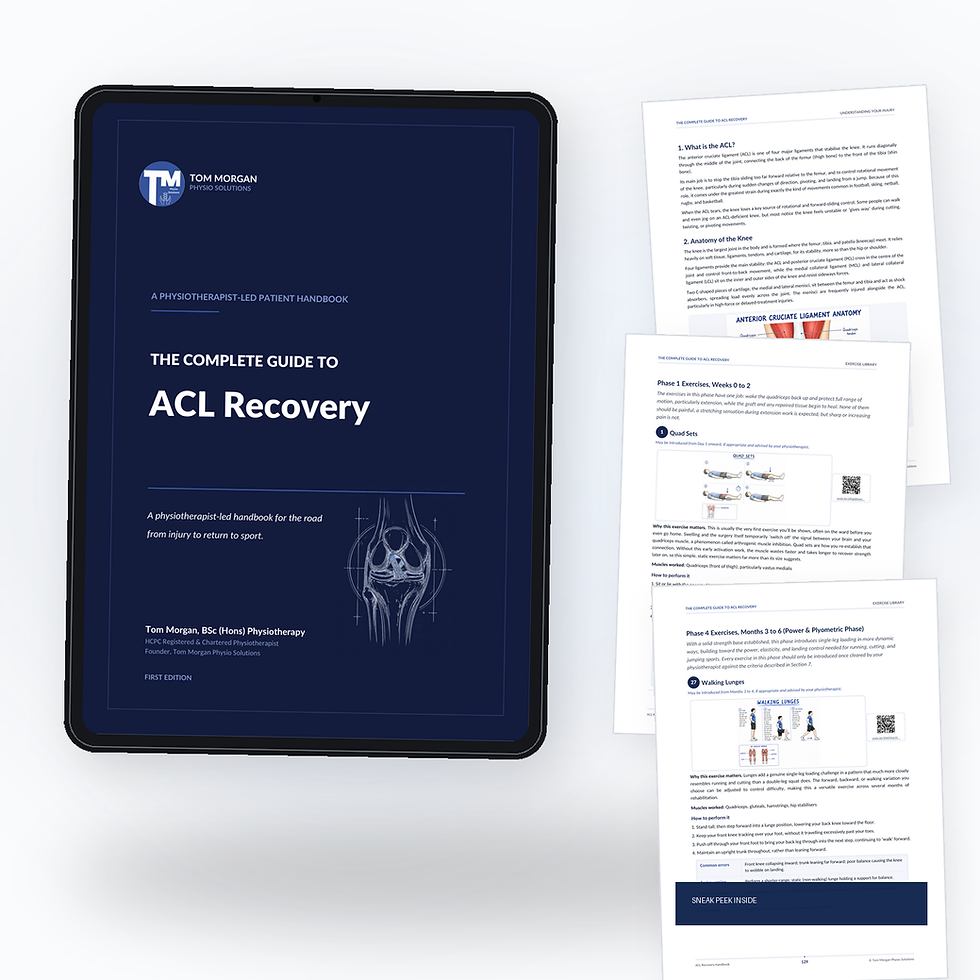
ACL Rehabilitation: Start Here – Free Advice + Complete £24.99 Guide

Updated: Sep 5
How ACL rehabilitation usually progresses
Early rehabilitation commonly focuses on settling swelling, restoring knee extension, regaining quadriceps control and normalising walking. As these foundations improve, rehabilitation shifts towards progressive lower-limb strength, single-leg control and increasing tolerance to gym-based loading. Running, jumping, landing, agility and return-to-sport work sit later in the pathway and should be introduced when the knee and the rest of the body can tolerate the required forces.
Strength matters beyond the quadriceps
Quadriceps strength is a major priority after ACL reconstruction, but successful rehabilitation is not built around one muscle alone. Hip strength, hamstring capacity, calf strength, trunk control and the ability to absorb and produce force through the whole limb all matter for running, jumping and changing direction. Rehabilitation should gradually become more demanding and more specific to the activities the person wants to return to.
Use symptoms as feedback, not the only progression test
Some discomfort or muscular fatigue can occur as loading increases, but a clear increase in knee swelling, loss of extension, deterioration in walking or a prolonged symptom flare suggests that the current dose may be too high. The response over the following day is often useful when judging whether a new exercise, running session or change in training volume was tolerated.
Return to running and sport
Return to running should normally come after adequate movement, strength and single-leg control have been rebuilt rather than simply when a particular number of weeks has passed. Return to sport requires a further step: repeated jumping and landing, change of direction, sport-specific conditioning and psychological confidence need to be rebuilt as well. Testing can help identify whether important deficits remain before unrestricted sport is resumed.
ACL rehabilitation is best organised into phases with entry and exit criteria. Early phases restore movement and control; middle phases build heavy strength and running capacity; later phases rebuild jumping, agility and sport-specific tolerance.
For this stage of ACL reconstruction rehabilitation, the most useful priorities are usually:
controlling swelling and restoring full knee extension early
re-establishing strong quadriceps activation
progressing walking and strength with good movement quality
using objective strength, hopping and control criteria before higher-risk sport
ACL rehabilitation should be criteria-based rather than driven only by the calendar. Time matters because the graft and tissues need to heal, but time alone does not prove that strength, control or confidence have returned. Progress when swelling is controlled, movement is appropriate for the stage and the previous level of loading is being tolerated well.
Use time as a minimum healing context, not the only progression rule. Each new phase should be supported by the movement, strength and symptom response needed to tolerate it.
chasing running or sport before basic strength has recovered
accepting persistent loss of knee extension
progressing because a certain week has arrived rather than because criteria are met
doing only isolated exercises and not rebuilding jumping, landing and change-of-direction capacity
When should you get extra help?
Seek review if the knee suddenly gives way with a new injury, swelling increases sharply after a twist, extension is progressively being lost, the wound becomes increasingly red or discharges, or pain and swelling are worsening rather than settling with appropriate load management.
For exercise and strengthening, start with movements you can perform consistently and progress one variable at a time: resistance, repetitions, range, complexity or total volume. The aim is adaptation, not proving how much discomfort you can tolerate in one session.
full knee extension and low reactive swelling
strong quadriceps activation and progressive leg strength
good movement quality with walking, squatting and single-leg tasks
criteria-based progression into running, jumping and sport
progressing several things at once, making it impossible to tell what caused a flare
chasing repetitions or distance while movement quality deteriorates
staying on very easy exercises for weeks after they have stopped being challenging
ignoring individual restrictions or red-flag symptoms because a generic timeline says you should be further ahead
If you need advice tailored to you, book a physiotherapy assessment.
Comments